



By Tom Bohner, founder of Solar Safe Pool Covers, an Arizona licensed contractor (CR-6 ROC #316530) manufacturing and installing custom pool covers in Phoenix & Tucson since 2002.
There are three situations when you should not put a solar cover on an Arizona pool:
- Mid-summer, when your water is already above ~90°F. A cover adds 10-15 degrees of passive solar heat: great in March, unwanted in July. Leaving the cover off overnight lets the pool shed heat through evaporative cooling.
- High-wind and dust-storm days, if you use a loose floating bubble cover. Unanchored covers can be lifted, flipped, or torn by monsoon-season gusts. (A deck-anchored cover like the PowerLock is the opposite: it should stay on and fully secured through a storm.)
- Right after adding chemicals. After shocking or heavy chemical treatment, run the pump and let the water circulate for 30-60 minutes before re-covering, so concentrated chemicals don’t sit against the underside of the cover.
The rest of the year, which in Arizona means most nights and any stretch when the pool isn’t being used, the cover should be on. Here’s the reasoning behind each situation, and where the common advice gets Arizona wrong.
First, Know Which Numbers Apply to Your Cover
Much of the generic advice online refers to floating bubble covers: the thin, bubble-wrap-style covers sold at pool stores. Those reduce evaporation by roughly 30-50%, and they’re the type that must come off in wind.
A custom-fitted, anchored cover is a different product with different numbers. Based on 22+ years of Solar Safe field measurements across Phoenix and Tucson, our PowerLock Solar Safety Cover reduces evaporation by approximately 95% and the HeatSaver Thermal Cover by approximately 90%. Those figures are independently consistent with Arizona Water Facts, which confirms a quality pool cover saves 90-95% of water lost to evaporation. In Phoenix and Tucson, an uncovered pool loses about 6 feet of water per year, roughly its entire contents (about 20,000 gallons), so the gap between 40% and 95% is thousands of gallons. See the full data on our Arizona pool evaporation page.
So the honest answer to “when should you not cover the pool?” depends on which cover you own.
Situation 1: Peak Summer Heat (Water Above ~90°F)
From late June through August, Phoenix and Tucson pool water can climb above 90°F on its own. Since a solar cover adds 10-15 degrees of passive heat, covering an already-hot pool during the day can push water past comfortable swimming temperature.
What to do instead:
- Leave the cover off overnight during the hottest weeks. Nighttime evaporation is what actually cools the water.
- If you have a HeatSaver, this is the one season its insulation works against you for comfort. Leave it off at night, and cover when the pool sits unused for days.
- If you have a PowerLock and small children or pets, safety wins: keep the cover on whenever the pool is unattended. The heat gain is a comfort trade-off; an uncovered pool is a safety risk.
Situation 2: High Winds and Monsoon Storms (Bubble Covers Only)
Monsoon season (roughly June 15 to September 30) brings outflow gusts and dust storms that will pick up a floating bubble cover, fold it, and drag it across the deck, shortening its life and leaving the pool exposed anyway.
If you have a floating bubble cover: remove and secure it when storms or sustained high winds are forecast.
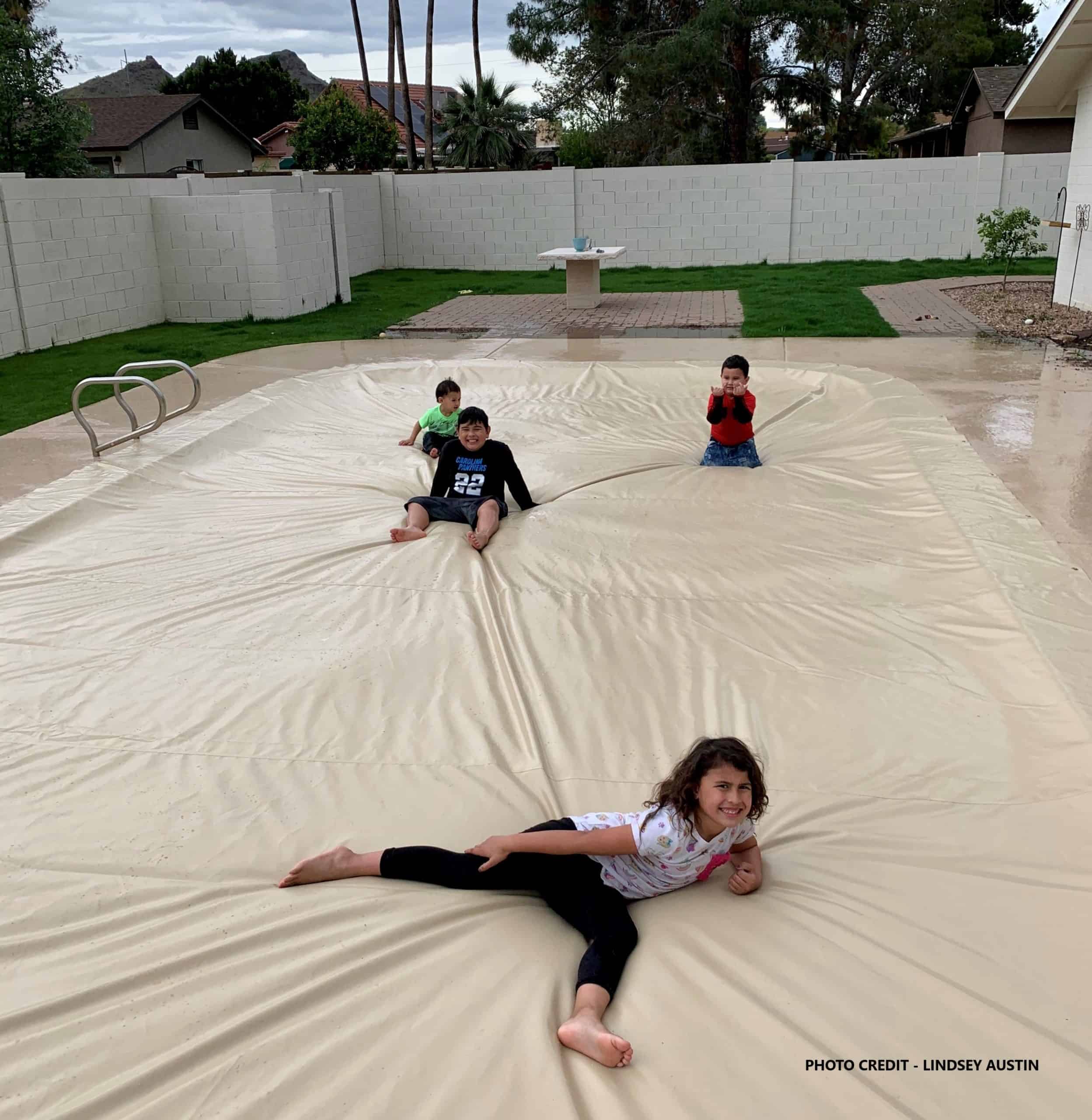
If you have a PowerLock: do the opposite. The cover is anchored to the deck and is designed to ride out the storm. This is when it earns its keep, keeping monsoon dust and debris out of the water.
Before a storm: secure every anchor, and set the provided cover pump on the cover with a hose run to a drainage spot. The cover fully supports the weight of storm water when the pool beneath it is at a proper level, and in Arizona, leftover storm water on the cover typically evaporates within a day or two. Full steps are in our monsoon FAQ.
Situation 3: Right After Adding Chemicals
After shocking the pool or adding a large chemical dose, leave the cover off and run the pump for 30-60 minutes. Covering immediately traps concentrated chemicals and off-gassing chlorine against the underside of the cover, which shortens the life of any cover material. Once the water has circulated, re-cover. A covered pool then makes those chemicals last dramatically longer, since UV burn-off is the main reason Arizona pools consume chlorine. (A PowerLock extends chemical life by over 80%.)
Every Other Night of the Year: Cover It
| Situation | Floating bubble cover | PowerLock / HeatSaver |
|---|---|---|
| Water above ~90°F (July-Aug) | Off | Off for cooling, on whenever unattended (safety) |
| Monsoon / dust storm forecast | Remove and store | Keep on, anchors secured, pump in place |
| Just added chemicals | Off 30-60 min | Off 30-60 min |
| Normal nights, spring & fall | On | On |
| Vacation / snowbird months | Risky to leave unattended | On; pool can be fully shut down |
The cost of not covering an Arizona pool is well documented: about 6 feet of water lost per year, faster chemical burn-off, constant debris cleanup, and (for families with young children) an unprotected pool. If your current cover is the kind you have to take off every time the wind blows, that’s a cover problem, not a covering problem.