


By Tom Bohner, founder of Solar Safe Pool Covers, an Arizona licensed contractor (CR-6 ROC #316530) manufacturing and installing custom pool covers in Phoenix & Tucson since 2002.
Yes. In Arizona you can leave your pool covered for the entire winter, and with the right cover you can leave it covered for years. What changes is the goal:
- Hibernate it. With an anchored PowerLock Safety Cover, you balance the water, secure the cover, and shut the pump off. No circulation, no chemicals, no service visits. Many owners top the water off once or twice a year and do nothing else.
- Keep it warm. With a HeatSaver Thermal Cover, you keep swimming. It retains up to 90% of the pool’s heat overnight, so a heated pool can cost up to 75% less to heat through the winter.
What you do not do in Arizona is winterize the way northern states do. Draining the pool, blowing out lines, and shutting everything down for the freeze is cold-climate advice that does not apply to Phoenix or Tucson, and a floating safety cover actually requires the water to stay in the pool.
When to Cover for the Season in Arizona
Arizona is not one climate. Timing depends on your elevation more than the calendar.
| Region | Typical cover-for-the-season timing |
|---|---|
| Phoenix, Tucson, and the low desert | Mid-November through mid-December, once water temperature drops out of comfortable swimming range |
| Flagstaff, Prescott, Show Low, and northern Arizona | Early October, ahead of the first hard freeze and snow |
These are starting points, not deadlines. A PowerLock can go on any week of the year, and plenty of low-desert customers cover in September simply because they are done swimming and want to stop paying to run the pool.
Option 1: Hibernate the Pool with a PowerLock
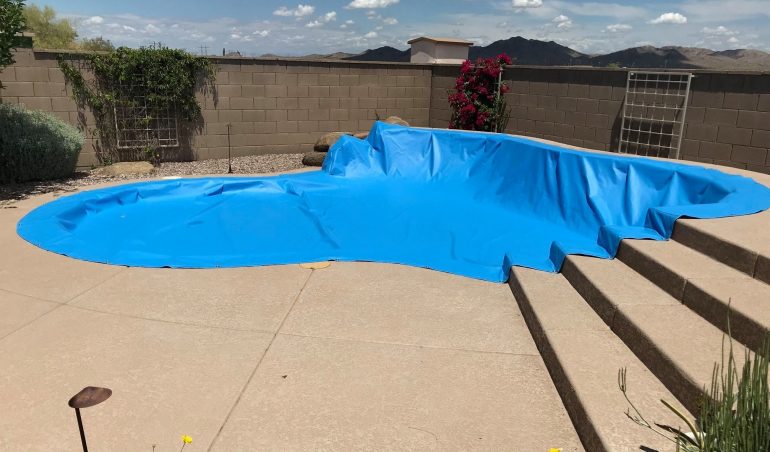
Hibernation is the part most Arizona pool owners do not realize is available to them. A solid vinyl safety cover blocks sunlight and seals off more than 90% of evaporation, and sunlight is what drives both algae growth and chlorine burn-off. Take the sun away from balanced water and the pool simply sits there. Not for a weekend. For months, or for years.
This is the single most common reason snowbirds, second-home owners, and families who are tired of the pool buy a PowerLock instead of filling the pool in.
How to hibernate an Arizona pool
- Clean the pool thoroughly. Brush, vacuum, and skim. Anything organic left on the floor is what you will be looking at in March.
- Bring the water to its normal level, about halfway up the skimmer opening or the middle of the top row of tile. A floating cover needs the water beneath it for support.
- Balance every chemical, not just chlorine. Free and total chlorine 1.0 to 3.0 ppm, pH 7.2 to 7.8 (7.4 is ideal), total alkalinity 80 to 120 ppm, cyanuric acid 50 to 100 ppm, calcium hardness 250 to 500 ppm, TDS under 1,200 ppm.
- Add a phosphate reducer and drive phosphates toward zero. Phosphates are algae food, and this is the step people skip.
- Do not shock and then immediately cover. Heavy chlorine concentration sitting against the underside of a cover damages the material. Circulate first.
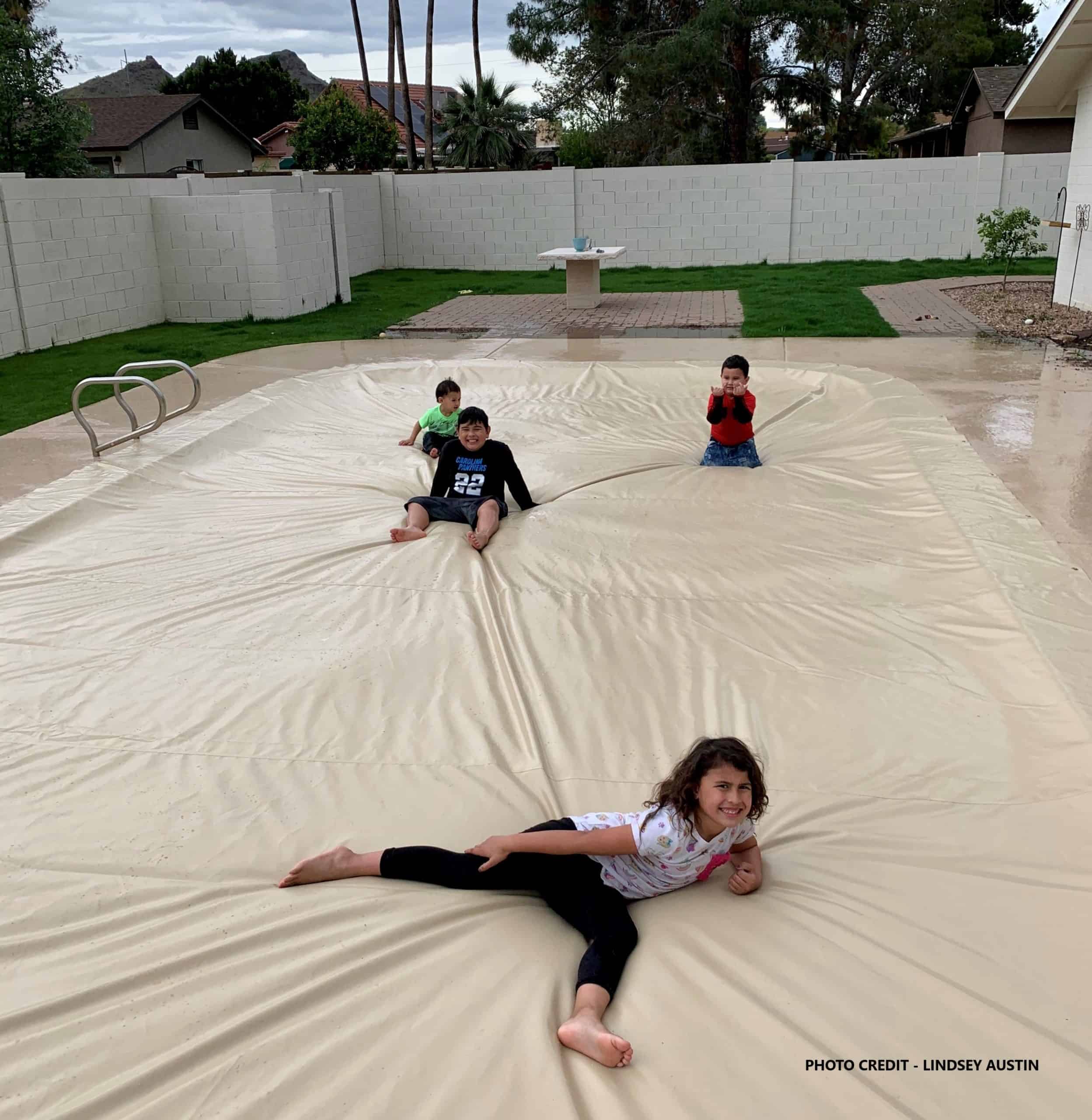
- Put the cover on and lock every anchor. A partially anchored cover does not meet the ASTM F1346-91 safety standard.
- Shut off the pump and filter. That is the step that stops the bills.
Through the winter, there is essentially nothing to do. Top the water off once or twice a year if you do not have an auto-leveler, and pump standing water off the cover after a storm. When you are ready to swim again, re-test and adjust the chemistry, then filter the full volume of the pool at least twice, roughly 24 to 48 hours, before anyone gets in.
Two honest cautions. First, if you are in northern Arizona where hard freezes are routine, have your equipment pad and plumbing properly winterized before you shut the pump off for the season. Second, if the water quality is already poor going into hibernation, it may not come back swimmable. Get the chemistry right first, or plan on draining and refilling in the spring.
What hibernation actually saves
- Chemicals: a covered pool typically needs up to 80% less chlorine, because UV burn-off is the main reason Arizona pools consume it.
- Water: solid vinyl seals off roughly 95% of evaporation. An uncovered Phoenix or Tucson pool loses close to 6 feet of water a year.
- Electricity: the pump is off, and the pump is usually the largest single electrical load in an Arizona backyard.
- Service: many customers drop their pool service company entirely for the season, or permanently.
Between those four, a PowerLock typically pays for itself in two to three years. Savings vary pool to pool, so treat these as ranges rather than promises.
Option 2: Keep Swimming with a HeatSaver
If you heat your pool or spa, winter is the season the HeatSaver was built for. It is a true insulating blanket, not a bubble cover: a cross-linked closed-cell polyethylene foam core sandwiched between two layers of 1600-denier woven fabric, independently tested at an R-value of about 1.8.
The reason that matters is where heated pools lose their heat. It is not through the walls. It is off the surface overnight, mostly through evaporation. A HeatSaver cuts evaporation by roughly 90% and retains up to 90% of the pool’s heat, so a covered pool typically drops only 1 to 3 degrees overnight instead of the much larger loss an open pool takes on a cold desert night.
Cut the overnight loss and your heater stops spending every morning re-heating water it already heated yesterday. That is where up to 75% lower heating costs comes from. It is also why we run an ASHRAE-based savings analysis with your actual location and utility rate before quoting, rather than asking anyone to take the number on faith.
Note the season. The HeatSaver is recommended for cold-weather use and is not recommended for continuous peak-summer sun. Winter is its element. It is also not a safety cover: it will not support weight, and every panel must be off and stored before anyone swims.
Which One for Your Winter?
| Your winter goal | PowerLock | HeatSaver |
|---|---|---|
| Shut the pool down for the season | Yes. Pump off, no chemicals, months or years | No. Pool still needs normal operation |
| Keep swimming in a heated pool | Adds 10 to 15°F of passive solar, but is not an insulator | Yes. Up to 90% heat retention, 1 to 3°F overnight loss |
| Child and pet safety while the pool sits unused | Yes. Exceeds ASTM F1346-91 | No. Not a safety cover |
| Leaving town for the winter | Yes. Built for exactly this | No |
| Winter storms and debris | Stays on and anchored; pump standing water off | Remove and store panels on the reel |
| Lowest winter operating cost | Near zero. Pool is off | Up to 75% less spent on heating |
What Not to Do
A few pieces of standard winterizing advice are actively wrong for an Arizona pool with a floating cover:
- Do not drain the pool. A PowerLock floats and needs the water underneath it for structural support. Low water also puts strain on the cover and the anchoring system during storms.
- Do not chase a high chlorine reading. Under a solid cover with no UV, 1.0 to 3.0 ppm is the target. Running chlorine high does not help and shortens cover life.
- Do not leave standing water sitting on the cover. Use the included cover pump. Water on top of the cover is a drowning hazard, and a cover is never a substitute for supervising children.
- Do not skip the anchors. Every locking anchor, every time, or the cover is not rated as a barrier.
The Short Version
Leaving your pool covered all winter in Arizona is not just allowed, it is the least expensive and safest way to get through the season. Cover it to hibernate and stop paying to run a pool nobody is swimming in, or cover it to hold heat and keep swimming for a fraction of the heating cost. The only bad option is an open pool sitting there evaporating, burning chlorine, collecting debris, and staying open to a child or a pet all winter.
Stop Paying to Run a Pool Nobody Is Swimming In
Every Solar Safe cover is custom designed, cut, and sewn on-site to fit your exact pool, including steps, boulders, water features, and attached spas. Free on-site estimate, no obligation, and financing is available.
Get My Free Estimate
Phoenix: (623) 869-6015
Tucson: (520) 232-2434
Family owned in Arizona for 22+ years. Made in the USA. Licensed, bonded & insured, CR-6 ROC #316530. BBB A+ and Google 5-Star rated.