


By Tom Bohner, founder of Solar Safe Pool Covers, an Arizona licensed contractor (CR-6 ROC #316530) manufacturing and installing custom pool covers in Phoenix & Tucson since 2002.
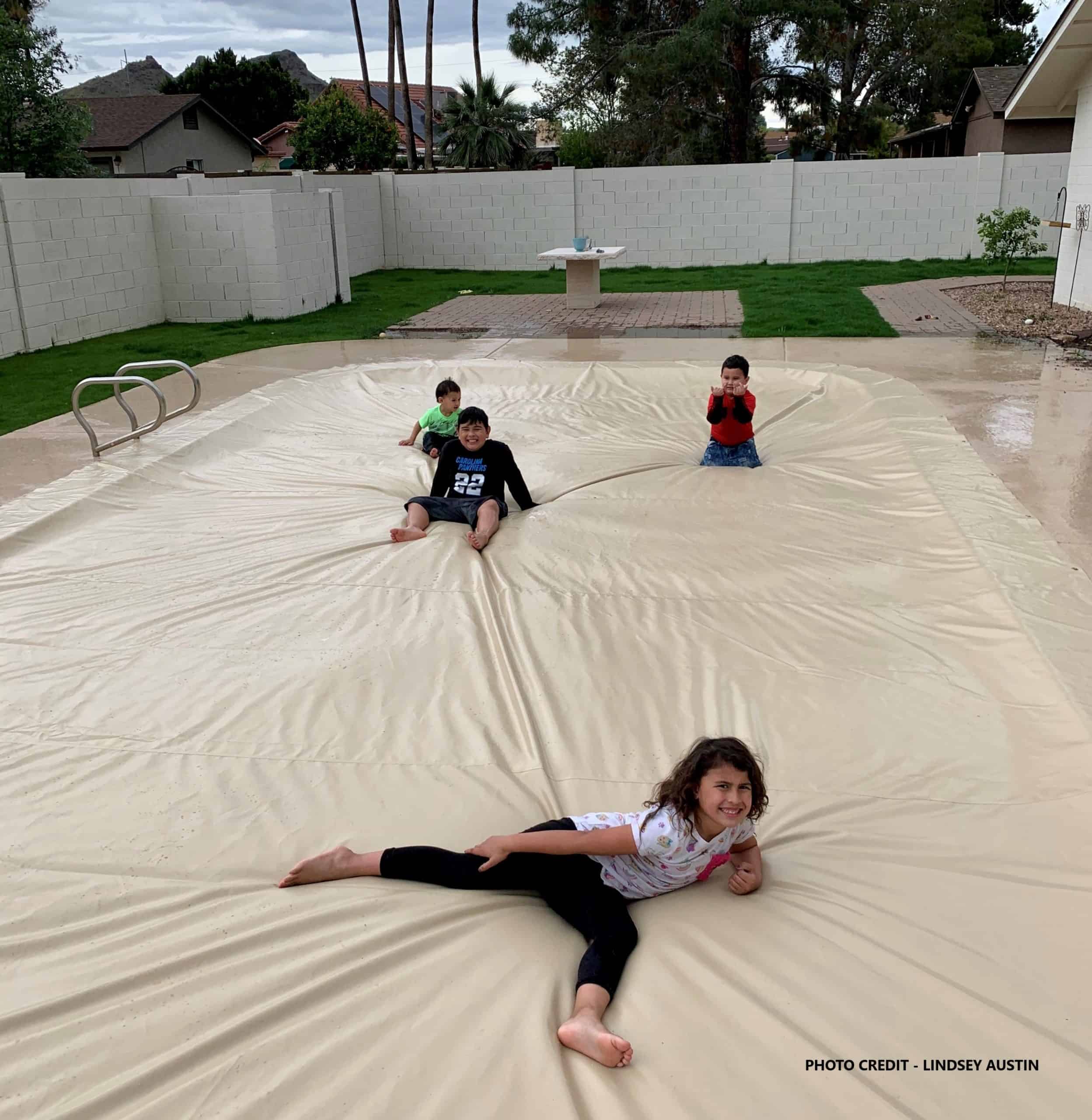
For most Arizona pools, the best thing to cover a pool with is a custom-fitted solid safety cover. It is the only option that does all four jobs at once: it keeps children and pets out of the water (a PowerLock Safety Cover exceeds the ASTM F1346-91 standard), seals off roughly 95% of evaporation, blocks the desert UV that burns through your chlorine, and lets you shut the pool down entirely when nobody is swimming.
The exception is a heated pool. If you want to keep swimming through the cool months, an insulated HeatSaver Thermal Cover holds up to 90% of the pool’s heat overnight and cuts heating costs. What you should not rely on in Arizona sun is a thin bubble solar blanket, a tarp, or a leaf net. None of them hold weight, and the cheap ones fall apart fast in UV.
“Best” is not the same for every pool, so start with your goal rather than a product. Here is how the real options compare in a desert climate.
Start With Your Goal, Not the Product
Almost every Arizona pool owner is trying to solve one of three problems. Which one is yours points straight at the right cover:
- Safety. Someone in the home is a young child, a pet, or a visiting grandchild. You need a barrier, not a blanket.
- Shutting the pool down. You are a snowbird, you travel, or you are simply tired of running a pool nobody swims in. You want to stop paying for water, chemicals, and electricity.
- Heating a pool you still swim in. You heat the water and want to keep the season going without a punishing gas or electric bill.
The first two point to a solid safety cover. The third points to a thermal cover. A bubble blanket, a tarp, or a net solves none of them well in this climate.
The Pool Cover Types Sold in Arizona, Compared
| Cover type | Holds a child’s weight? | Blocks UV & debris? | Evaporation cut | Holds heat? |
|---|---|---|---|---|
| Bubble / solar blanket | No | Partially | 30 to 50% | A little passive gain |
| Tarp | No | Debris only | Minimal | No |
| Leaf net | No | Debris only | None | No |
| Thermal cover (HeatSaver) | No | Yes, while on | ~90% | Yes, up to 90% retained |
| Solid safety cover (PowerLock) | Yes, exceeds 485 lb | Yes, full barrier | ~95% | Adds 10 to 15°F passive solar |
The pattern is hard to miss. Only two cover types earn their keep in Arizona, and each one wins for a different owner.
Why a Solid Safety Cover Wins for Most Arizona Pools
A solid, anchored safety cover is the closest thing to a single answer this question has. It is the only cover that is a genuine safety barrier and a water-and-chemical saver and a pool shutdown switch at the same time. The PowerLock is a solid vinyl fabric with a polyester mesh core that floats on the surface; its edge locks to the deck with dime-sized brass anchors set about 30 inches apart, and the combined strength of the anchors and vinyl supports the weight of an entire family, well beyond the ASTM F1346-91 requirement of 485 pounds.
In a desert climate, the same solid barrier that stops a child also does the practical work:
- Water. An uncovered Phoenix or Tucson pool can lose close to 6 feet of water a year to evaporation. Solid vinyl seals off roughly 95% of it.
- Chemicals. UV burn-off is the main reason Arizona pools drink chlorine. Block the sun and a covered pool typically needs up to 80% less.
- Cleaning. Nothing blows in. No leaves, no dust from the 20-plus dust-storm days the low desert averages, no monsoon debris.
- Full shutdown. Balance the water, secure the cover, shut the pump off, and the pool can sit for months or years. Many owners top the water off once or twice a year and do nothing else.
Between water, chemicals, electricity, and dropped pool service, a PowerLock typically pays for itself in two to three years. Savings vary pool to pool, so treat those as ranges rather than promises.
A safety cover is not a babysitter. No barrier ever replaces adult supervision. Always lock every anchor, because a partially anchored cover does not meet the ASTM standard. And pump standing water off promptly after a storm: water on top of the cover is itself a drowning hazard, since a child can drown in as little as an inch.
When a Thermal Cover Is the Better Choice
If you heat your pool or spa and want to keep swimming into the cool months, heat retention becomes the priority, and that is a different cover. The HeatSaver is a true insulating blanket, not a bubble sheet: a cross-linked closed-cell polyethylene foam core sandwiched between two layers of 1600-denier woven fabric, independently tested at an R-value of about 1.8.
Heated pools lose most of their heat off the surface overnight, mainly through evaporation. A HeatSaver cuts that evaporation by roughly 90% and holds up to 90% of the pool’s heat, so a covered pool often drops only 1 to 3 degrees overnight instead of the much larger loss an open pool takes on a cold desert night. Your heater stops re-heating the same water every morning, which is where up to 75% lower heating costs comes from.
Two limits worth knowing. The HeatSaver is a cold-weather cover: it is not recommended for continuous peak-summer sun. And it is not a safety cover. It will not support weight, and every panel must be off and stored before anyone swims. Many owners who heat in winter keep a PowerLock for year-round safety and shutdown, and use the HeatSaver during the heating season.
What to Skip in the Arizona Sun
Cheaper covers look tempting on a shelf, but the desert is hard on them and none is a safety device:
- Bubble / solar blankets. They add a little passive heat and cut some evaporation, but continuous Arizona UV breaks the plastic down, and a degrading blanket sheds bubbles and flakes into the water. It holds no weight at all.
- Tarps. A tarp keeps leaves out and does almost nothing else. It sags, collects water, and pulls loose in monsoon wind.
- Leaf nets. Useful under trees for catching debris, but they let sun, evaporation, and small dirt straight through, and a child can fall right into the water.
Any of these can play a small supporting role, but none is “the best thing to cover a pool with” if you care about safety, water, or a real reduction in maintenance.
What It Costs
| Cover | Typical installed price | Best for |
|---|---|---|
| PowerLock Safety Cover | $3,500 to $7,500 (about $50 to $80/mo financed) | Safety, water and chemical savings, shutting the pool down |
| HeatSaver Thermal Cover | $3,000 to $6,000 (about $37 to $63/mo financed) | Keeping a heated pool or spa warm through the cool months |
Every cover is custom priced, because size, shape, deck type, boulders, steps, and water features all factor in. There is no off-the-shelf version: each Solar Safe cover is measured, cut, and sewn on-site to fit your exact pool, and a correct custom fit is part of what makes the safety rating hold.
The Bottom Line
The best thing to cover an Arizona pool with is a custom solid safety cover for most homes, because it is the only option that protects children and pets, saves water and chemicals, and lets you shut the pool down, all at once. If your pool is heated and you want to keep swimming, an insulated thermal cover is the better tool for that job. The bubble blankets, tarps, and nets on the shelf each do one small thing, but none stands up to the sun or holds any weight. Match the cover to your goal and the choice makes itself.
Not Sure Which Cover Fits Your Pool?
Tell us your pool and your goal and we will recommend the right cover, then measure, cut, and sew it on-site to fit exactly, including steps, boulders, water features, and attached spas. Free on-site estimate, no obligation, and financing is available.
Get My Free Estimate
Phoenix: (623) 869-6015
Tucson: (520) 232-2434
Family owned in Arizona for 22+ years. Made in the USA. Licensed, bonded & insured, CR-6 ROC #316530. BBB A+ and Google 5-Star rated.