
Natural gas, propane, an electric heat pump, or solar: every one of them is refilling the same hole. Put in your pool size and target temperature and see what that hole costs you each year, and what closing it is worth.
The U.S. Environmental Protection Agency calls pool covers the most effective way to cut evaporation, and reports that covering a heated pool saves between 50 and 70 percent of its heating costs. Read the EPA WaterSense guidance (PDF)
A pool loses heat four ways: evaporation, radiation to the night sky, convection to moving air, and conduction into the ground. In Arizona, evaporation alone is about 72 percent of it, because our air is dry enough to pull water off the surface almost every hour of the year.
Natural gas, propane, or an electric heat pump. Each one buys heat at a very different price per BTU, so the same lost heat produces a very different bill.
Surface area drives evaporation, so it drives everything. Then pick your target temperature. Every degree warmer widens the gap between your water and the air, and the losses climb faster than most owners expect.
What an open pool costs you per year, and what the same pool costs under a HeatSaver cover 20 hours a day. The gap is the money you are currently spending on heat that leaves overnight.
Why the numbers are large. Heating a pool is not like heating a house. A house loses heat through insulated walls. An open pool loses it off a bare water surface directly into the sky, with no barrier of any kind. That is why covering the surface is one of the most effective ways to lower what it costs to heat a pool.
Choose how your pool is heated, natural gas, propane, or an electric heat pump, then set your pool size and target temperature. Results update as you move the sliders.
Heated by a solar system? Your fuel is already free, so an uncovered pool costs you temperature rather than dollars. See what a cover changes for solar.
| Water Lost to Evaporation (uncovered): | |
|---|---|
| Water Lost with HeatSaver Cover: | |
| Heating Energy Needed (uncovered): | |
| Current Energy & Water Cost: | |
| Projected Cost with HeatSaver Cover: | |
| Total Annual Savings: |
Estimates only. Your actual bill depends on current Arizona gas, propane, electric, and water rates, how warm you keep the water, and how consistently the cover goes on. Pools larger than 5,000 square feet are commercial work, so see commercial pool covers.
Your heater sets the price of heat. It has no effect at all on how much you lose. That is why the cover is the one upgrade that pays off no matter what is bolted to your equipment pad, and why it is the only one that gets cheaper to justify as fuel gets more expensive.
What a million BTU of delivered pool heat costs in Arizona
Fuel price divided by heater efficiency. Lower is cheaper per unit of heat, not cheaper overall.
Read this carefully. Solar has no fuel bill, which makes it look like the row that does not need a cover. It is the row that needs one most. A solar system collects heat for six to eight hours a day and then an uncovered pool spends all night giving it back. Free heat that leaves before morning still leaves you with cold water.
| What we are comparing | Natural Gas | Propane | Electric Heat Pump | Solar Water Heater |
|---|---|---|---|---|
| Cost per million BTU delivered | $21.76 | $39.05 | $9.09 | No fuel cost |
| Uncovered pool, per year | about $3,500 | about $6,200 | about $1,550 | Paid in lost degrees |
| What goes wrong without a cover | Cheap enough per BTU that the waste hides in a bill that never looks alarming. Half to two thirds of it is replacing heat that left overnight. | The same losses at nearly twice the price of gas. You feel it as refill frequency rather than as a monthly line item. | Cheapest per BTU but the slowest to deliver, and it loses output as the air cools. In spring and fall it cannot out-run an open pool's overnight loss. | Collects only in daylight and loses it all night. Systems are sized assuming the heat stays in the pool. |
| What a HeatSaver changes | Burner run time drops sharply, and so does the bill. | The largest dollar saving of any heat source, because you are avoiding the most expensive heat. | Often the difference between a heat pump that reaches your setpoint and one that never quite does. A capability gain, not just a saving. | Holds overnight what the panels collected all day, which is the job the system was sized around. |
Annual figures are for a 450 square foot pool held at 82 degrees year round in Phoenix, calculated with the same engine as the calculator above. Solar is shown without a dollar figure on purpose: with no fuel to buy, an uncovered solar pool pays for evaporation in temperature it never reaches rather than in money.
How we get there, and why our number is higher than the EPA's. Our model follows the approach of Energy Smart Pools, software the U.S. Department of Energy released in the 1990s under its Reduce Swimming Pool Energy Costs (RSPEC) program, rebuilt with current ASHRAE heat-loss equations and Phoenix weather data. The EPA credits pool covers with saving 50 to 70 percent of pool heating costs nationally. Our model runs higher, and the reason is Phoenix. Evaporation is about 72 percent of heat loss here because the air is so dry, so shutting it down removes more of the total than it would in a humid climate. The model also assumes the cover is on 20 hours a day.
Cover the pool less and the savings fall accordingly: at roughly 12 hours a day the model lands right inside the EPA's 50 to 70 percent band. Treat the EPA range as the conservative floor and the calculator as what diligent daily use looks like in Arizona.
Of the heat a Phoenix pool loses, roughly 72 percent leaves as evaporating water. The EPA identifies evaporation as the largest single source of pool energy loss.
Air cools faster than water, the gap widens, and the pool radiates to a clear desert sky. Your heater spends the morning buying back what left in the dark.
Per EPA WaterSense guidance for heated pools. Consistency is what decides where in that range you land.
Every gallon that does not evaporate is a gallon you do not refill and heat energy you do not replace. One cover, two line items.
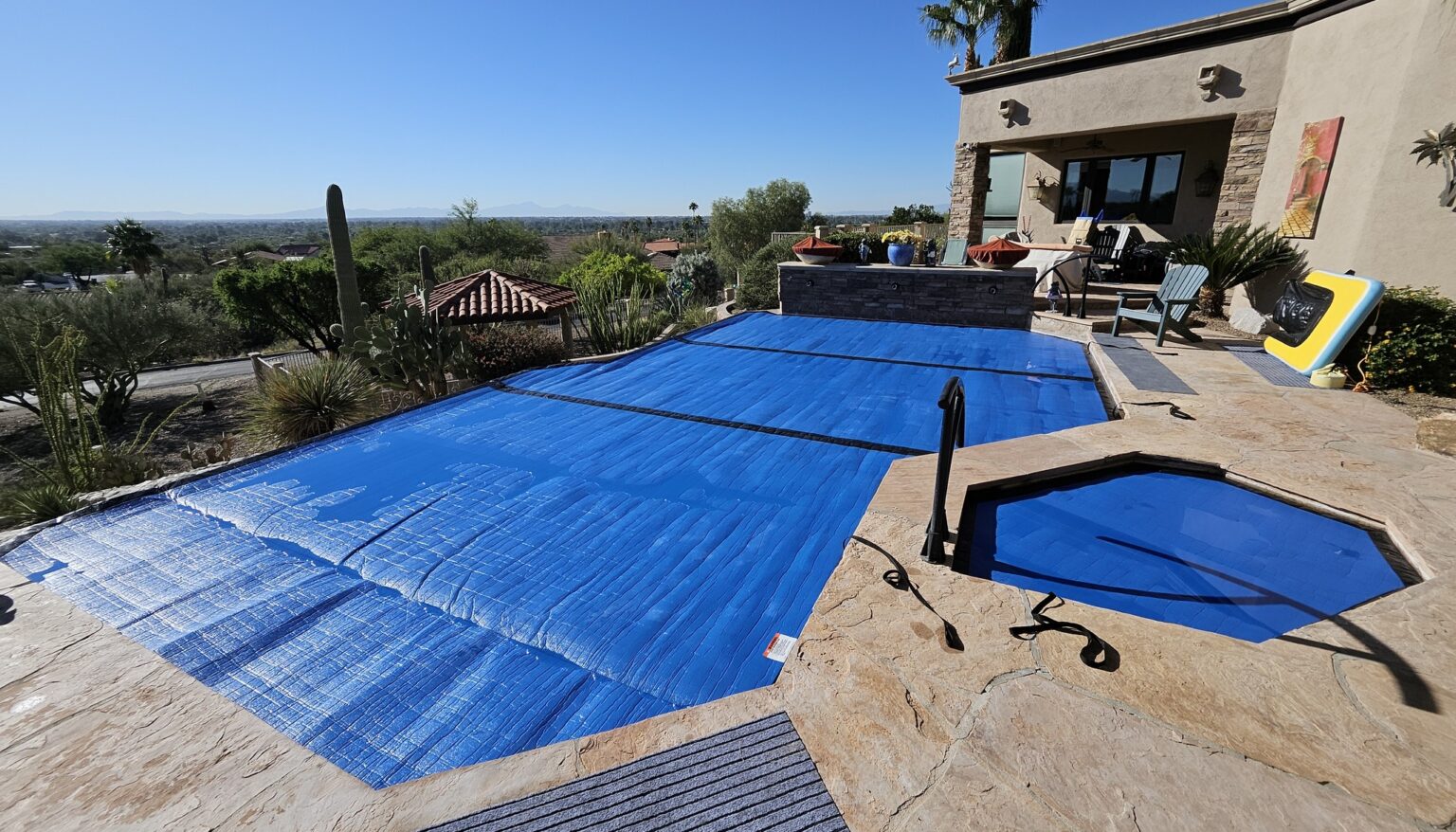
A HeatSaver is a custom-fitted insulating cover with a cross-linked closed-cell foam core, not a floating sheet of air cells. It is cut and sewn to your pool's actual shape, which is what lets it seal the surface rather than approximate it.
| What we are comparing | Open pool | With a HeatSaver |
|---|---|---|
| Evaporation from the surface | Continuous, every hour of the year | Cut about 90 percent while covered |
| Heater run time | Replacing overnight losses every morning | Sharply reduced, whatever the heat source |
| Overnight radiant loss to the sky | Unobstructed bare water surface | Blocked by an insulating barrier |
| Water top-off | About 29,600 gallons a year on a 450 sq ft pool | About 7,400 gallons, roughly 75 percent less |
| Debris and cleaning load | Everything that blows in lands in the water | Kept off the surface entirely |
Evaporation is the mechanism behind all of it, and it is worth understanding on its own terms. We break it down in detail on pool water evaporation, and the cover itself is spec'd out on the HeatSaver thermal cover page.
Commercial pools. Everything above scales, and the economics get more compelling as the surface area grows. Hotels, HOAs, schools, and municipal facilities can see five-figure annual savings on a single body of water. See commercial pool covers.
It uses the ASHRAE 2019 Handbook heat-loss methodology, the same engineering basis used to size commercial pool equipment, applied to Phoenix Sky Harbor monthly weather averages from 2020 to 2024. It computes evaporation, convection, radiation, and conduction month by month, then subtracts monthly solar gain. It is an engineering estimate rather than a quote: your real bill depends on your utility rates, how warm you actually keep the water, and how consistently the cover goes on. The savings it shows are in the same territory as the 50 to 70 percent heating cost reduction the U.S. EPA attributes to pool covers, and higher when the cover is used diligently in a climate as dry as ours.
For a typical 450 square foot residential pool held at 82 degrees year round in the Phoenix area, our model puts an uncovered pool at roughly $3,500 a year in natural gas and water, at $1.85 per therm and 85 percent heater efficiency. The same pool under a HeatSaver cover 20 hours a day runs a few hundred dollars. Move the sliders above to match your own pool, since surface area and target temperature both change the answer substantially.
Yes, by a wide margin. At $3.00 per gallon, propane delivers heat at about $39 per million BTU compared with about $22 for natural gas, so nearly twice the price for the identical heat. Propane owners also tend to notice it differently: instead of a monthly bill that creeps up, you get refills that come around faster than you expected. Because you are buying the most expensive heat on the list, you also have the most to gain from not losing it. Our model shows the largest annual dollar savings of any heat source for propane-heated pools.
It helps in a way that matters even more than the dollars. A heat pump buys heat cheaply, about $9 per million BTU, but it delivers that heat slowly and its output drops as the outside air gets cooler. On an uncovered pool in spring or fall, a heat pump can end up running almost continuously and still never reach your setpoint, because the pool is losing heat overnight faster than the unit can put it back during the day. A cover cuts the overnight loss so the heat pump you already own can actually get the water where you want it. For a lot of heat pump owners the cover is what makes the system work, not just what makes it cheaper.
Solar is the heat source that depends on a cover the most, which surprises people. Solar panels collect heat for six to eight hours a day. An uncovered pool then spends the following fourteen to eighteen hours giving that heat back to the night sky through evaporation and radiation. Solar pool heating systems are sized on the assumption that the water retains heat between collection cycles, so running one on an open pool asks it to do a job it was never sized for. Because there is no fuel bill, the loss does not show up as money. It shows up as water that never quite reaches the temperature you wanted and a season that ends earlier than it should.
The U.S. EPA estimates that pool covers cut heating costs by 50 to 70 percent, and calls them the most effective method of reducing evaporation. In Phoenix specifically the number tends to run higher, because our air is dry enough that evaporation accounts for roughly 72 percent of all heat loss, so suppressing it removes more of the total than it would in a humid climate. Consistency is the variable that matters most: a cover on the pool 20 hours a day saves dramatically more than one used a few nights a week.
Because every loss mechanism scales with the gap between your water and its surroundings. Raising the setpoint widens that gap for all 8,760 hours of the year at once. Evaporation is the harshest of the four: warmer water raises its own vapor pressure, so the driving force behind evaporation grows faster than the temperature difference does. Two degrees warmer is not two degrees more expensive, it is meaningfully more. Try moving the temperature slider a single degree and watch the annual figure move.
They are different products, and the difference shows up in three places.
Construction. A bubble blanket traps air in cells. A HeatSaver has a cross-linked closed-cell foam core. Trapped air and foam insulation do not behave the same way once the sun goes down and the pool starts radiating to the night sky.
Fit. A bubble blanket is sold in stock rectangles and trimmed to approximate your pool. A HeatSaver is cut and sewn on site to the actual shape, including steps, benches, and raised features. This is the part people underestimate, and the EPA is direct about it: it rates solar and bubble covers at 50 to 95 percent evaporation reduction and says that range varies based on shape and coverage. A custom-sewn cover takes the shape-and-coverage variable off the table, and since evaporation is roughly 72 percent of heat loss here, the gaps at the edges are where the money leaks out.
Lifespan. A bubble blanket typically gives two to four seasons in Arizona sun. See the HeatSaver thermal cover page for materials and warranty.
Whatever heats your water, the cheapest BTU is the one you never lose. We will measure your pool, build the cover here in north Phoenix, and fit it on site.
Arizona's only pool cover manufacturer. Family-owned since 1980. Licensed CR-6, ROC #316530.